Pallets for bin stores are the stock behind a store where shoppers dig through bins and pay a flat price that usually steps down as the week goes on. The model lives on cost per unit, a steady mix and enough volume to refill the bins. This page covers the lots bin store owners buy, how to price them and how to size an order.
A bin store owner’s restock, from pallet to bin
Picture an owner with eight empty bins and a flat-price schedule that steps down each day of the week. The first job is to know what a pallet is worth per unit, because a unit that cost $4 and sells for $5 on the last day leaves nothing for rent.
Next the pallet gets broken down. Units are sorted into bins by size and category, anything broken is pulled, and the high-value pieces are set aside for a shelf or an online listing. That sorting is real labor, and a pallet with 300 units costs more of it than one with 80.
The week then runs on turnover. Fresh bins draw regulars on the first day, and whatever is left gets cheaper until the next restock. An owner who restocks on a steady rhythm, with a mix of lot types, tends to keep the floor interesting.
What pallets for bin stores usually contain
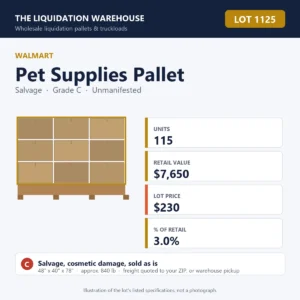
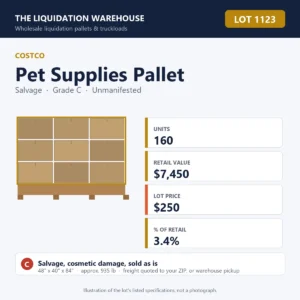
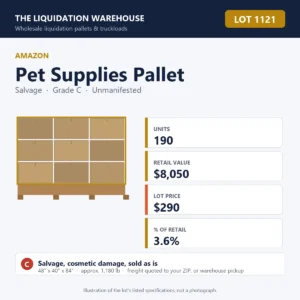
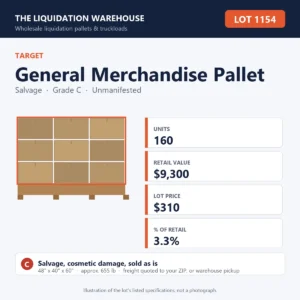
Most bin store pallets are general merchandise: small appliances, kitchen gadgets, toys, tools, bedding, electronics accessories, pet items and home decor. That is why general merchandise pallets and Amazon return pallets are common starting points.
Each lot lists its source retailer, so you can match the likely mix to your own shoppers. A neighborhood that wants kitchen items and toys needs a different pallet from one that wants tools and hardware. The wider liquidation pallets range shows every lot type, and condition decides how much work follows, which comes up below.
Bin store pallet pricing and the margin per bin
Cost per unit is the number a bin store lives on. Suppose a $1,200 pallet holds 300 units, so each unit costs $4, and the average sale after the markdown schedule lands at $7. That leaves $3 a unit before freight, rent and labor, and the margin shrinks fast if a third of the units never sell.
Freight is quoted to your ZIP code, and warehouse pickup is available, so compare both whenever pickup is realistic for you. Put those figures into the pallet profit calculator with your own markdown schedule before you commit.
Grades, manifests and checks before units go into a bin
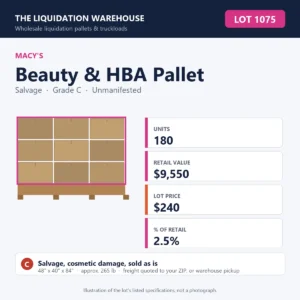
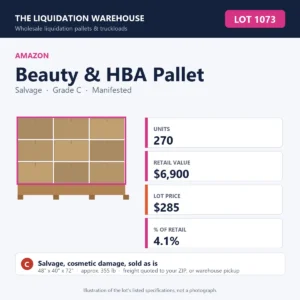
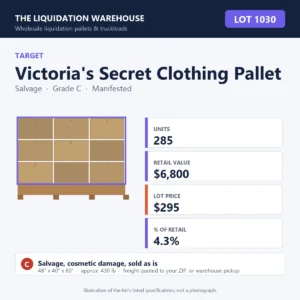
Bin stores can handle rougher stock than a shelf store, since a low price covers flaws. Grade A, sealed or store stock, is the easiest to put in a bin, and it can be shelved apart at a higher price. Grade B is opened customer returns, so test what you can and label the rest honestly. Grade C is salvage sold as is with cosmetic damage, which belongs in the cheapest bin.
Manifested lots have the manifest emailed on request before you buy, which lets you plan the bins on paper. Unmanifested lots are sold as is with no item list, and some bin store owners are comfortable with that because the bin hides the variance. Either way, run a few quick checks.
- Pull anything with missing parts or a cracked screen and price it separately.
- Test the electronics you can, and label the rest as untested.
- Check dates on health and beauty or pantry items.
- Photograph the best units for your online channel before they hit a bin.
Sizing the first order for a bin store
A first order should match the number of bins you can fill and sort in a week. A single pallet first tells you the real mix and the real sort time. Bin store truckloads are the next step. Once the arithmetic works, full trailer truckloads spread freight and handling across 22 to 28 pallets, and they only make sense if you have the dock, floor space and labor for them.
The guide on how to open a bin store covers the rest of the setup. If you have surplus inventory of your own to move rather than stock to buy, the page on how to sell to us is the place to start.